
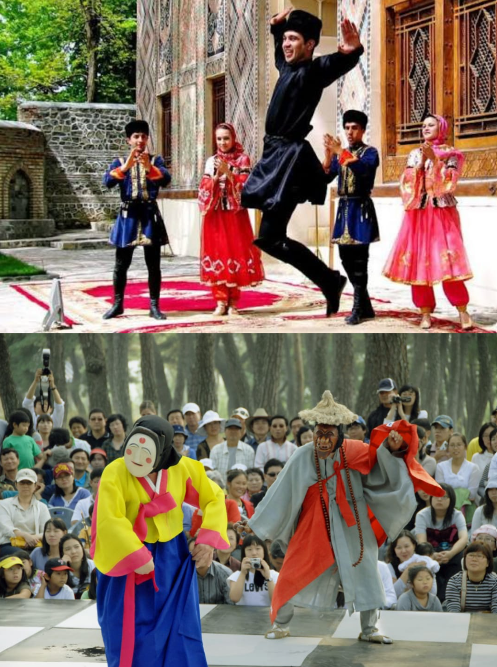
There are hundreds of countries in the world belonging to different cultures, languages, and peoples. The diversity of each of them makes the world even more beautiful. Every year, various cultural events are organized and different festivals are held to preserve traditions that have survived from the past to the present.
South Korea is also one of the countries known and loved all over the world for the richness of its culture. There are some common features that connect South Korean culture with Azerbaijani culture. Events are organized and projects are carried out to preserve and maintain the traditions of both countries. In Azerbaijan, the number of young people who love Korean culture, especially those interested in 한류 (han-ryu) — the Korean Wave, is gradually increasing. The Korean Wave currently shows how developed Korea is in the fields of media and music. This especially includes K-pop and K-dramas.
The traditional clothing of South Korea is called 한복 (han-bok). Its magnificent design attracts people. Various accessories such as 비녀 (bi-nyeo), 떨잠 (tteol-jam) and 댕기 (daeng-gi) were used in their hair. It can be said that these accessories had a similar function to the traditional accessories used by Azerbaijani women, such as araxçın, kəlağayı and təsək qabağı. In both Korea and Azerbaijan, hair ornaments differed according to different social classes and family statuses. For example, in Korea, brides used a hair accessory called 족두리 (jok-du-ri) during weddings. In Azerbaijan, red veils were used and this tradition is still used today. Grooms used a black hat called 사모 (sa-mo) during weddings. This is similar to the national hat used by Azerbaijani grooms. In the past, as footwear, they wore shoes called 혜 (hye) with hanbok. This can be compared to çarıq or çəkmə. Also, in Korea, they wore socks called 버선 (beo-seon) with traditional shoes.
Azerbaijani cuisine and Korean cuisine are very different from each other. However, each of them is loved and appreciated around the world for its own taste and uniqueness. 송편 (song-pyeon) and 약과 (yak-gwa) can be given as examples of South Korea's traditional sweets. These are very different from our şəkərbura and pakhlava. Also, 호박엿 (ho-bak-yeot), a pumpkin candy that was very popular in Korea in the past, was also very loved. The closest example to this in Azerbaijan can be considered noğul, but they are different.
They even had a belief that eating hobakyeot would bring success in an exam. Since this candy was sticky, it carried the meaning of, in a way, having good luck stick to you.
One of Korea's most important holidays is 추석 (chu-seok). During this holiday, family members gather and hold a special memorial ceremony. According to their beliefs, their deceased relatives come to visit them during this holiday. Although it is different from the Novruz holiday in Azerbaijan, the atmosphere is almost the same. In Azerbaijan, families also come together and prepare special foods and sweets.
The cultures of both countries are broad and diverse. Their depths are even more beautiful and attract people to learn about them more deeply. By learning about the cultures of countries closely, we can feel how beautifully people have truly made the world. Preserving traditions and passing them on to future generations is very important. This is the most valuable heritage left to us by past generations and preserving our culture is the duty of each of us.
Nuray Babayeva